Skip to content
Politecnico di Milano, SIGMA Lab

Research

Research

Five research areas spanning extreme loading, health monitoring, digital twins, artificial intelligence and mechanical metamaterials, combining experimental, numerical and data-driven methodologies.

Areas
5
Projects
30
Laboratories
4
Courses
14

Areas

Research areas

Open an area for its topics, publications and thesis topics.

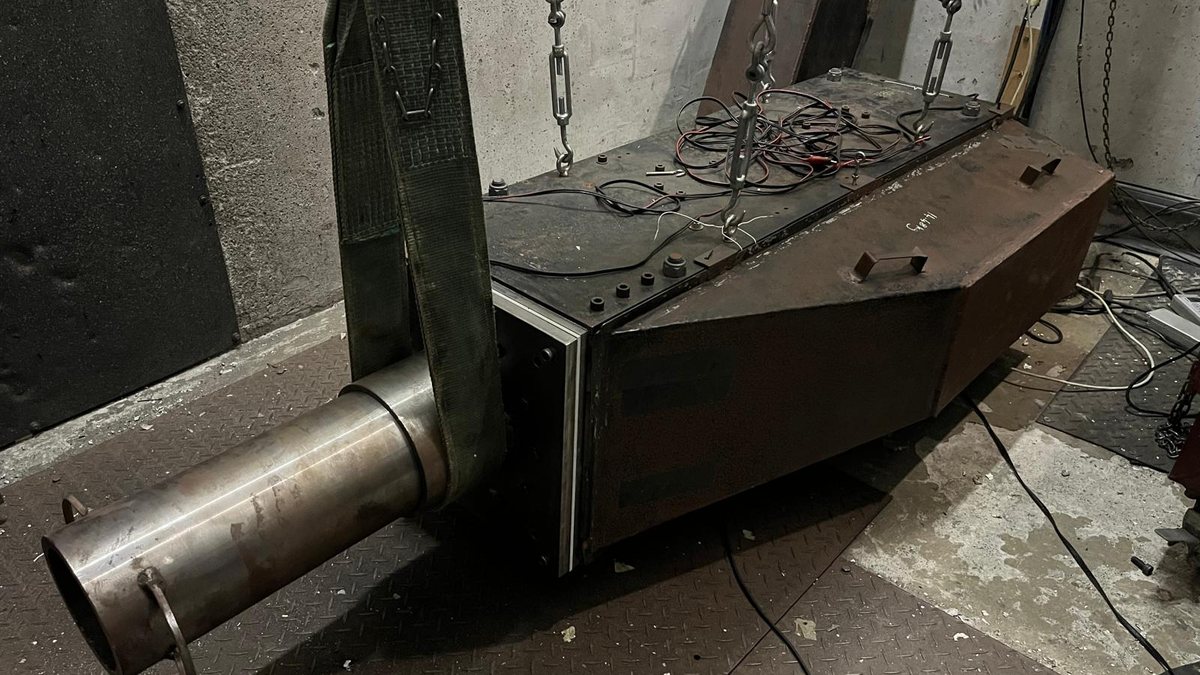
Blast-test fixture instrumented for extreme-load experiments

Research area

Structural Integrity Under Extreme Loads

Programme head · Andrea Manes

How materials and structures behave when loading becomes nonlinear and severe — large deformation, fracture, impact and blast. The programme runs from material calibration on coupons through to full-scale experimental validation, pairing every test with an analytical or numerical model so that protection can be designed predictively rather than by trial.

Failure and Loading Phenomena

  • Crashworthiness and energy-absorbing structures
  • Large deformation, failure, cracking and delamination
  • Terminal ballistics: hyper-, high- and low-velocity impact
  • Explosion and blast loading, in air and underwater
  • Vulnerability and survivability assessment

Modelling and Testing

  • Material calibration with innovative constitutive laws
  • Metals, composites, ceramics, glass and geological materials
  • Modelling of energetic materials
  • Multiscale approaches, down to nanofillers
  • Numerical modelling: FEM, DEM and meshless methods
  • Experimental testing from micro to full scale
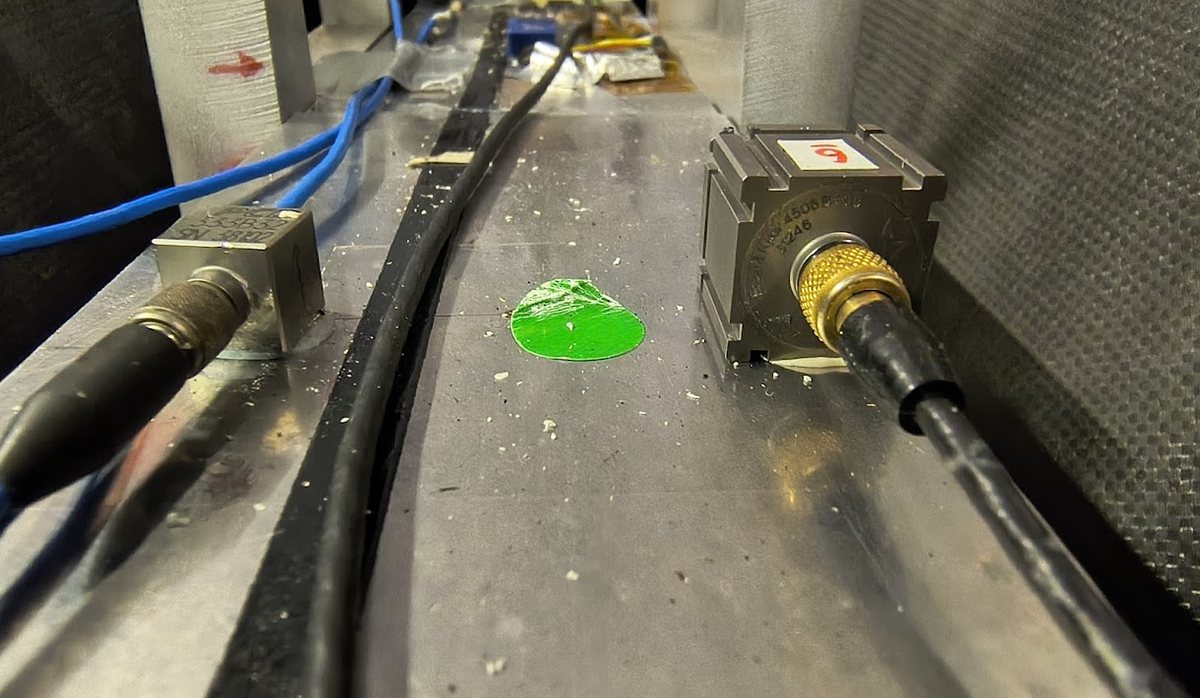
Instrumented test beam with accelerometers and cabling

Research area

Structural and System Health Monitoring

Programme head · Claudio Sbarufatti

Detecting, locating and sizing damage from sensor networks installed on operating structures, then predicting how much life remains. Sensors give a signal that depends on damage; numerical models supply the simulated experience needed to interpret that signal. The goal is safer operation at lower maintenance cost.

Sensing and Diagnosis

  • State-of-the-art sensor technologies for SHM
  • Optical sensors and piezoelectric transducers
  • Nanoparticle-based sensing
  • Data-driven feature extraction
  • Damage identification from guided waves and strain

Prognosis and Qualification

  • Model-based algorithms for diagnosis and prognosis
  • Monte Carlo sampling for stochastic prognosis
  • Remaining useful life prediction
  • Experimental SHM verification
  • Performance qualification of monitoring systems
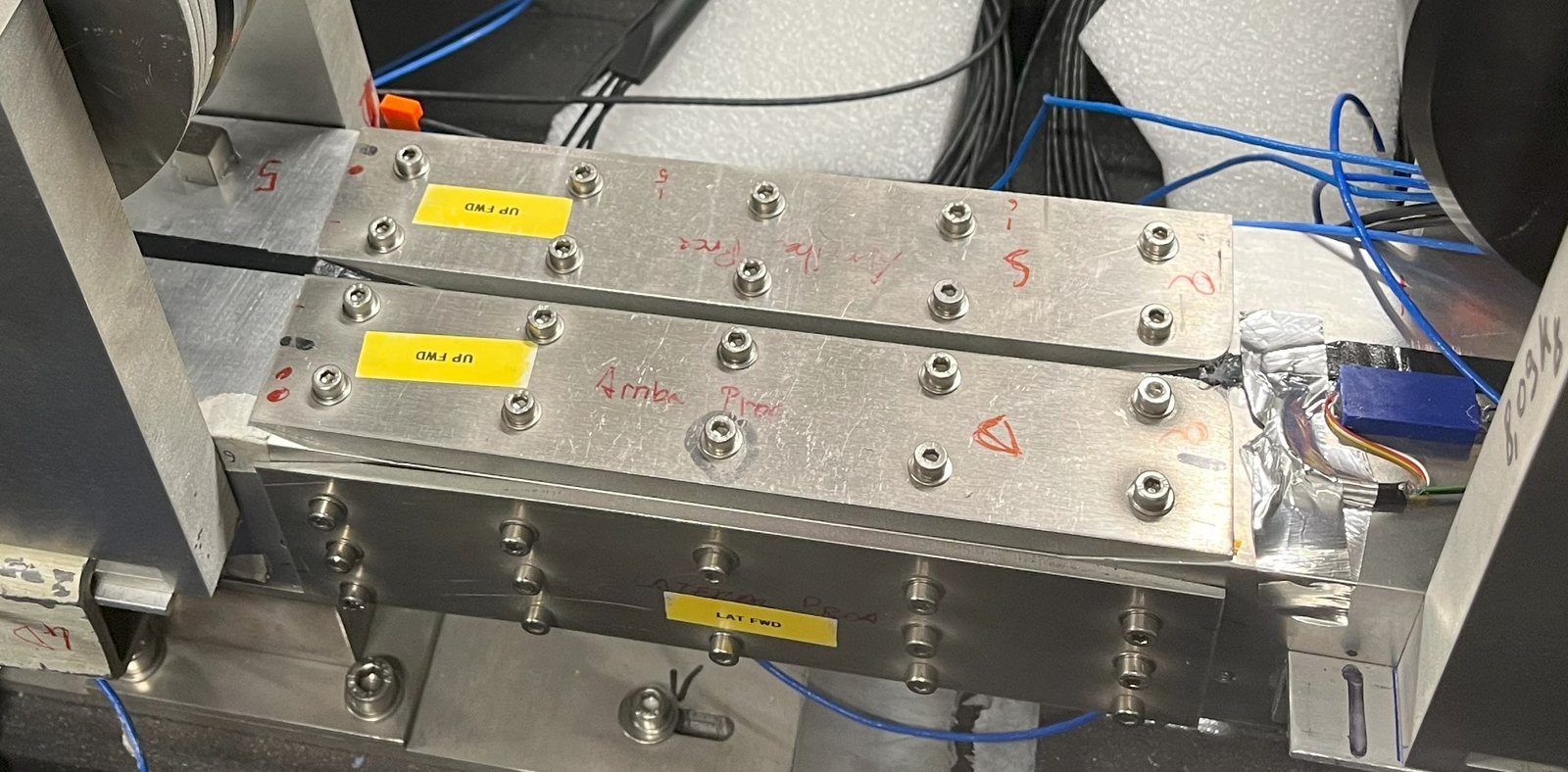
Instrumented structural test fixture used for digital-twin validation

Research area

Digital Twins for Structures and Systems

Programme head · Claudio Sbarufatti

A digital twin is a set of models, both physics-based and data-driven, that update themselves in real time and follow the life of the physical system they represent. It must carry information about how degradation develops, and run fast enough to keep up with operation. The programme builds twins at component, platform and fleet level.

Twinning Strategies

  • Digital twinning of structures and systems subject to degradation
  • Surrogate modelling for fast model deployment
  • Reduced order models
  • Real-time model updating
  • Shape sensing algorithms
  • Stochastic parameter identification and degradation prediction

Application Scenarios

  • Health and usage monitoring systems
  • Load monitoring and fatigue life consumption
  • Fleet-level monitoring and life-cycle management
  • Ship hulls and naval platforms
  • Space exploration systems
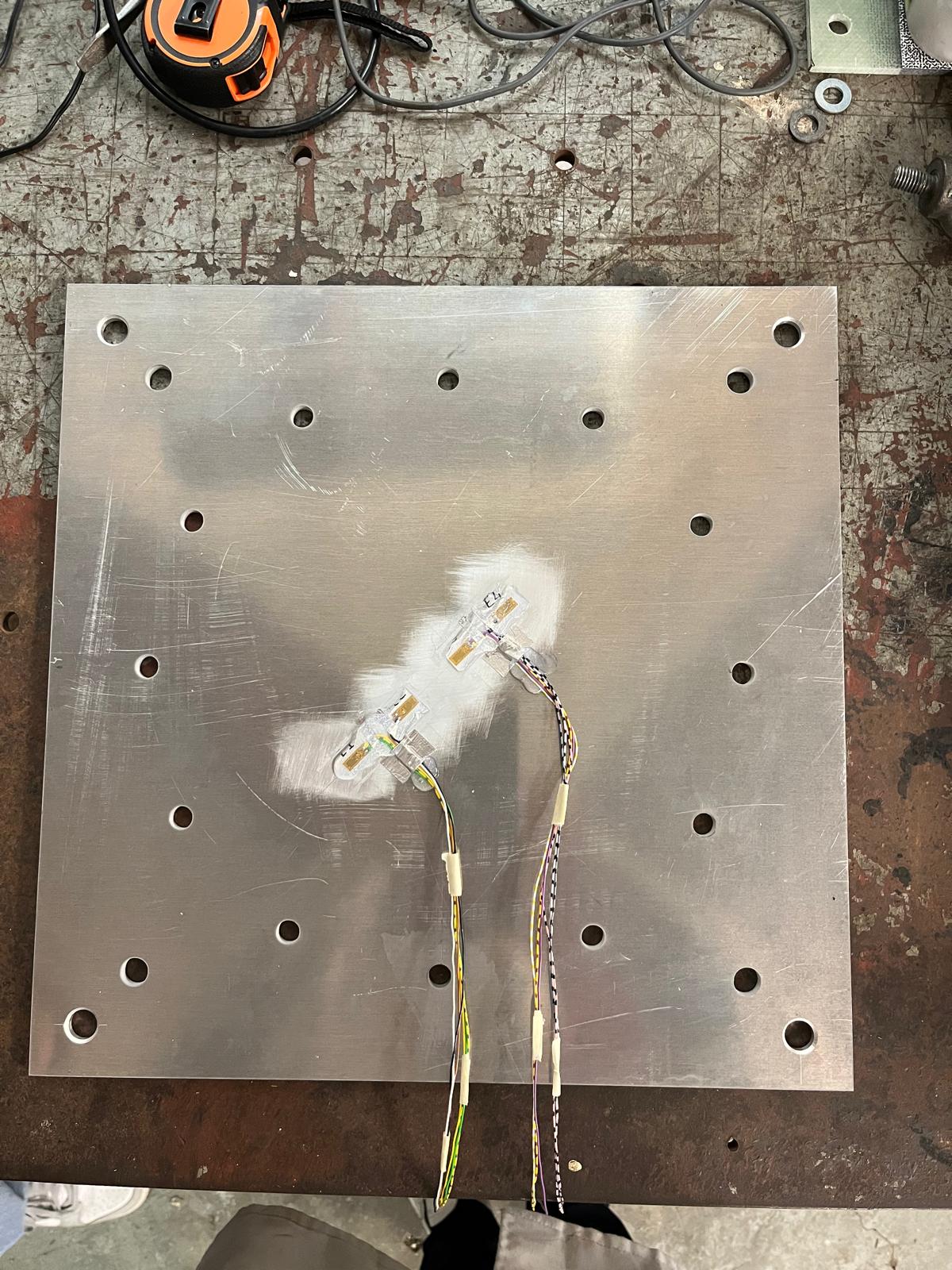
Strain gauges and sensor wiring on a metallic test plate

Research area

AI for System Integrity Design and Operation

Programme head · Francesco Cadini

Modern systems are interconnected, multiphysical and heavily instrumented, and the signals they produce are too complex for hand-built features. Deep learning handles that, but labelled data for damaged conditions is scarce and black-box predictions are hard to trust. The programme works on both problems: embedding physics to cut the data requirement, and making predictions explainable.

Learning Architectures

  • Hybrid models fusing physics-based knowledge with operational data
  • Deep architectures: CNNs, RNNs and Transformers
  • Physics-informed neural networks (PINNs)
  • Graph neural networks for spatially distributed systems
  • Generative models (GANs, VAEs) for data augmentation

Trust and Application

  • Explainable AI for trustworthy predictions
  • AI-assisted design optimisation
  • Reliability-based and robust design
  • Battery management systems
  • Propulsion subsystems and energy storage
3D-printed lattice under compression beside its finite element von Mises stress field

Research area

Mechanical Metamaterials for Extreme Dynamics and Wave Control

Programme head · Luca Lomazzi

How architected materials can be designed to achieve tailored responses under dynamic loading and to control elastic-wave propagation. The research combines computational modeling, experiments, and machine learning to develop metamaterials for impact mitigation, programmable mechanical behavior, and tunable wave manipulation.

Dynamic Loading Response

  • Inverse design of mechanical metamaterials for targeted static and dynamic responses
  • Disordered metamaterials with custom, robust, and tunable mechanical behavior
  • Mechanical neural networks and topology-informed computational architectures
  • Metamaterials for impact mitigation, energy absorption, and extreme dynamic loading
  • Multiphysical metamaterials with magnetically controllable mechanical properties
  • Numerical modeling and experimental characterization from unit cells to full-scale structures

Elastic Wave Control

  • Fractal and hyperbolic architectures for elastic wave control
  • Elastic-wave filtering, guiding, localization, and attenuation
  • Phononic crystals and graded metamaterials for rainbow effects
  • Inverse design for targeted wave-propagation behavior
  • Magnetorheological-fluid and magnetorheological-elastomer metamaterials
  • Field-controlled tuning of stiffness and wave propagation
  • Machine-learning surrogate models and generative design methods

Capabilities

Capabilities

Research activities run inside the laboratories of the Department of Mechanical Engineering, whose structural and material testing facilities are among the best equipped in Europe. Every experimental campaign is paired with an analytical or numerical model, so that a validated model can stand in for a test that would otherwise be slow, costly or impossible to run.

Experimental Testing

  • Coupons and small specimens for mechanical characterisation
  • Full-scale component tests, including for FAA certification
  • Quasi-static tension, compression and torsion at varying temperature
  • Fatigue testing and hardness measurement
  • Drop tower for subsystem tests under extreme loading
  • Optical microscopy, SEM with EDS and EBSD probes
  • X-ray diffractometry, CT scanning and hot isostatic pressing

Material Calibration

  • Metals, ceramics, composites and nanocomposites
  • Inverse methods for identifying mechanical properties
  • Nano, micro and macro scale approaches
  • Constitutive models for high plasticity and ductile or brittle failure
  • Strain rate and delamination behaviour
  • Purpose-written routines for non-standard materials

Numerical Modelling

  • Analytical ballistic models: cavity expansion, energy balance and wave theory
  • Explicit finite element analysis in ABAQUS and LS-DYNA
  • High strain rate, high temperature and high pressure regimes
  • Fracture, damage, large fragmentation and delamination criteria
  • Blast loading and fluid–structure interaction
  • Lagrangian, ALE, SPH and peridynamics, including mesh-free coupling
  • Multibody and acausal simulation in Simulink and Simscape

Laboratories

Where the work happens

B16, via La Masa 34

Test of Mechanical Components

Static and dynamic testing of real components and full structures. Servo-hydraulic actuators to 1000 kN, electrodynamic shakers to 25 kN, load cells and displacement, rotation, pressure and temperature transducers, and a MIL-STD-810G qualified optical fibre interrogator.

Laboratory page

B13, via La Masa 34

Material Testing

Static and dynamic tests on materials and small components. A triaxial servo-hydraulic machine rated to 250 kN axial and 2000 Nm torsional, monoaxial machines from 15 to 100 kN, resonant testing machines, creep-fatigue rigs to 1200 °C, environmental chambers and 3D digital image correlation.

Laboratory page

B23-A, via La Masa 1

Non-destructive Tests

Experimental and simulation means for non-destructive testing and structural health monitoring. Phased array and conventional ultrasonics, electromagnetic acoustic transducers, acoustic emission, eddy current, X-ray micro-computed tomography, portable X-ray diffractometry and probability-of-detection characterisation.

Laboratory page

B6, via Candiani 72

High Strain Rate Lab

The interdepartmental impact facility, whose management committee includes Andrea Manes. A 700 J drop tower with instrumented impactors, a fast traction machine exceeding 30 kJ, two pneumatic cannons reaching 200 m/s, megahertz-rate acquisition and high-speed video.

Laboratory page

Projects

Projects since 2009

Projects coordinated or joined by SIGMA Lab, funded by the European Defence Agency, the European Defence Fund, Horizon 2020, the Italian Ministry of Defence, the Italian Space Agency and industry.

30 projects · select a project for its full description

Coordinated by POLIMI Partner or other role Dates announced, not final Bars open the project; the grid view lists the same data.
2010201220142016201820202022202420262028

EDA

HECTOR
ASTYANAX
ISSA
SAMAS
PATCHBOND II
NEXTPROP
SAMAS 2
BATTAGE
NEXTPROP II

EDF

dTHOR
COMMANDS
FMBTech
MaJoR

H2020 & JRC

ENHAnCE
DAMASCO

Ministry of Defence

SUMO
SUMO2
DIGIT-ART
ZENIT
CRANOS
SWARM
ARNES
Air-ENEMON
IRONMAN
POSEIDON
MODHEAL

Space Agency

DIGES
EXTESA

Regional

MISTICO
DE-LIGHT
  • European Defence Agency

    HECTOR

    HElicopter fuselage Crack moniToring and prognosis through on-board sensOR

    Propose modelling techniques for the analysis of multiple sensors in producing a unified and comprehensive method for identification, monitoring and prognosis of potential damages (like cracks) in the fuselage of a helicopter.

    Period
    2009–2011
    Funding
    EDA JIP-ICET · Grant A-0779-RT-GC
    Role
    POLIMI Coordinator
    Countries
    Italy, Poland, Norway, Greece
    Consortium
    CMR · SINTEF · UNIZA · AGH · AgustaWestland · Vitrociset
  • European Defence Agency

    ASTYANAX

    Aircraft fuSelage crack moniToring sYstem And progNosis through on-boArd eXpert sensor network

    Development of methodology for applying Structural Health Monitoring systems to aircraft structures, extending prior HECTOR project results to operational vehicles with certification considerations for real-world deployment. Two damage types were studied: local plastification from overloads such as hard landings, and fatigue crack growth. Total project budget €4.89M across three nations.

    Period
    2012–2015
    Funding
    EDA Ad Hoc R&T · Grant B 1288 ESM2 GP
    Role
    POLIMI Coordinator
    Countries
    Italy, Poland, Spain
    Consortium
    AleniAermacchi · AgustaWestland · AFIT · MAN No.1 · AGH · INTA
  • European Defence Agency

    ISSA

    Integrated Simulation of Non-Linear Aero-Structural Phenomena Arising On Combat Aircraft In Transonic Flight

    Creating validated analytical methods and tools for investigating limit cycle oscillations in fighter aircraft configurations operating in transonic conditions. Coordinator: AleniAermacchi.

    Period
    2013–2016
    Funding
    EDA Ad Hoc R&T · Grant B 1190 ESM2 GP
    Role
    Partner
    Countries
    Italy, Sweden
    Consortium
    AleniAermacchi (coord.) · POLIMI · SAAB · KTH
  • European Defence Agency

    SAMAS

    Structural Health Monitoring Application to Remotely Piloted Aircraft Systems

    A load monitoring system for remotely piloted aircraft built from both real and virtual sensor nodes, combining numerical simulation of the structure with data acquired on board into a single consistent statistical picture. Prof. Marco Giglio served as Scientific Manager.

    Period
    2017–2020
    Funding
    EDA Ad Hoc R&T Cat. B · Grant B 1404 GP
    Role
    POLIMI Coordinator
    Countries
    Italy, Poland
    Consortium
    POLIMI (coord.) · Leonardo S.p.A. · Air Force Institute of Technology · Military Aviation Works No. 1
  • European Defence Agency

    PATCHBOND II

    Certification of Adhesive Bonded Repairs for Primary Aerospace Composite Structures

    Experimental and numerical study of damage onset and growth in adhesively bonded repair patches for primary composite aerostructures, with structural health monitoring techniques — including inverse FEM strain and shape sensing — used to track debonding.

    Period
    Since 2020
    Funding
    EDA Cat. B · B.PRJ.RT.670
    Role
    Partner
    Countries
    Netherlands, Norway, Italy, Germany, Finland, Czech Republic
  • European Defence Agency

    NEXTPROP

    Next Generation of Propellers

    Hydro-elastic software and design tools for next-generation, low-noise naval propellers in composite materials, covering CFD, finite element analysis, fluid-structure interaction and theoretical models, validated on a generic foil and a typical propeller. SIGMA Lab contributes material testing and characterisation and nonlinear structural modelling of composites under extreme loads. Coordinated by FFI, the Norwegian Defence Research Establishment.

    Period
    2020–2025
    Funding
    EDA Ad Hoc R&T Cat. B · Grant B-1466-GEM1-GP
    Role
    Partner
    Countries
    Norway, Italy, Poland
    Consortium
    FFI (coord.) · FiReCo · Light Structures · SINTEF Ocean · CETENA · CNR-INM · POLIMI · Polish Naval Academy
  • European Defence Agency

    SAMAS 2

    Structural Health and Ballistic Impact Monitoring and Prognosis on a Military Helicopter

    Increasing helicopter availability by monitoring corrosion degradation directly, detecting ballistic impact occurrence, and — where a crack nucleates — tracking its propagation through the structure. The work combines sensor networks, reduced-order-model FEM simulation and machine learning into a digital-twin model.

    Period
    2021–2024
    Funding
    EDA Ad Hoc R&T Cat. B · B PRJ-RT 1074
    Role
    POLIMI Coordinator
    Countries
    Italy, Poland
    Consortium
    POLIMI Dept. of Mechanical Engineering (coord.) · Leonardo Helicopters Division
  • European Defence Agency

    BATTAGE

    Prognostic Health Management Methods for Structural Li-ion Batteries for Aeronautical Applications

    Prognostic health management for structural lithium-ion batteries in aeronautical use, where the battery carries load as well as storing energy and both functions degrade together.

    Period
    2025–2028
    Funding
    EDA Cat. B
    Role
    POLIMI Coordinator
  • European Defence Agency

    NEXTPROP II

    Next Generation of Propellers II

    Follow-on to NEXTPROP, continuing the structural integrity and modelling work on next-generation propeller designs.

    Period
    Expected 2026
    Funding
    EDA Cat. B
    Role
    Partner
  • European Defence Fund

    dTHOR

    Digital Ship Structural Health Monitoring

    The next generation of predictive ship structural health monitoring: a digital twin of the ship continuously updated by a network of real and virtual sensors, built on open data-exchange standards and hybrid physics-based and data-driven models, for better battle damage and structural integrity assessment. SIGMA Lab brings digital twins, AI algorithms for health and usage monitoring, and high-fidelity structure and material models. Consortium of 35 members.

    Period
    2022–2025
    Funding
    European Defence Fund · EDF-2021-NAVAL-R-2 · Grant 101103257
    Role
    Partner
  • European Defence Fund

    COMMANDS

    Convoy Operations with Manned-unManneD Systems

    Through-life capabilities for agile, intelligent and cooperative manned and unmanned land systems, based on unmanned ground vehicles on integrated modular open architectures and demonstrated on a last-kilometre re-supply convoy with force protection. SIGMA Lab brings digital twins and AI for health and usage monitoring, and tools for situation awareness. Consortium of 21 members.

    Period
    2022–2025
    Funding
    European Defence Fund · Call 2021
    Role
    Partner
  • European Defence Fund

    FMBTech

    Technologies for existing and future Main Battle Tanks

    Defining the best innovative technologies within a modular main battle tank system architecture, so that existing and future European tanks reach the highest operational effectiveness and mission success. SIGMA Lab brings structural health monitoring, HUMS and AI-based maintenance decision support from aeronautical platforms to land systems, alongside vulnerability and survivability analysis and high-fidelity simulation of protection systems. Consortium of 26 partners, coordinated by Thales.

    Period
    2024–2027
    Funding
    European Defence Fund · Call 2023
    Role
    Partner
  • European Defence Fund

    MaJoR

    Maintenance, Joining and Repair innovation in multidomain defence

    A platform providing the test environment for technologies that advance joining, maintenance and repair across air, sea and land domains. SIGMA Lab works on the numerical simulation of composite-metal joints under blast load. Consortium of 35 partners.

    Period
    2024–2028
    Funding
    European Defence Fund · Call 2023
    Role
    Partner
  • Horizon 2020 and the Joint Research Centre

    ENHAnCE

    European Training Network in Intelligent Prognostics and Health mAnagement in Composite structurEs

    Marie Skłodowska-Curie Innovative Training Network turning composite structures into intelligent cyber-physical systems: embedded sensors for real-time damage identification, simulation tools for sensor–damage interaction, and self-adaptive prognostics algorithms. SIGMA Lab hosts early-stage researchers within the network, co-supervised by Prof. Francesco Cadini. Coordinated by Universidad de Granada.

    Period
    2020–2024
    Funding
    H2020 MSCA-ITN-2019 · Grant 859957
    Role
    Partner
    Countries
    Spain, Italy, Netherlands, Belgium
    Consortium
    Univ. Granada (coord.) · POLIMI · TU Delft · Cenaero · CEA Tech List · FIDAMC · Strathclyde · Nottingham
  • Horizon 2020 and the Joint Research Centre

    DAMASCO

    Dynamic Armour Materials and Structures Characterization for defence applicatiOns

    Granted access to the physical research infrastructure of the Joint Research Centre of the European Commission. The extreme mechanical properties of penetrator and armour materials demand the specialised instrumentation available at the ELSA HopLab; the calibration supports reliable predictive methods for innovative protections. Access runs from 8 October 2024 to 8 October 2026.

    Period
    2024–2026
    Funding
    EU Joint Research Centre · ELSA HopLab
    Role
    Granted access
  • Italian Ministry of Defence

    SUMO

    Development of a predictive model for ballistic impact

    Period
    2012–2013
    Funding
    Italian Ministry of Defence
    Budget
    €875k
  • Italian Ministry of Defence

    SUMO2

    Analytical, numerical and experimental method for the design of multilayer composite ballistic protections

    Period
    2017–2018
    Funding
    Italian Ministry of Defence
    Budget
    €2.1M
  • Italian Ministry of Defence

    DIGIT-ART

    Digital twin and artificial intelligence towards a condition-based maintenance approach

    Period
    2021–2023
    Funding
    Italian Ministry of Defence
    Budget
    €1.8M
  • Italian Ministry of Defence

    ZENIT

    HUMS and vulnerability / survivability methodologies applied to RPAS platforms

    Period
    2022–2024
    Funding
    Italian Ministry of Defence
    Budget
    €1.7M
  • Italian Ministry of Defence

    CRANOS

    Predictive methods for the design and optimisation of ballistic helmets

    Period
    2023 · 9 months
    Funding
    Italian Ministry of Defence
    Budget
    €883k
  • Italian Ministry of Defence

    SWARM

    Digital twin development for the health and usage monitoring of UAV swarms

    Period
    2024 · 24 months
    Funding
    Italian Ministry of Defence
    Budget
    €2.0M
  • Italian Ministry of Defence

    ARNES

    Research on naval platforms subject to underwater explosions

    Period
    2024 · 12 months
    Funding
    Italian Ministry of Defence
    Budget
    €880k
  • Italian Ministry of Defence

    Air-ENEMON

    AI-based HUMS for a hybrid UAV power system, supporting operations and maintenance optimisation

    Period
    2024 · 18 months
    Funding
    Italian Ministry of Defence
    Budget
    €1.7M
  • Italian Ministry of Defence

    IRONMAN

    Residual resistance estimate of SAPI protections through advanced methods

    Period
    Expected 2026
    Funding
    Italian Ministry of Defence
    Budget
    €2.24M
  • Italian Ministry of Defence

    POSEIDON

    Predictive methodologies for simulating threats acting on different naval platforms

    Period
    Expected 2026 · 18 months
    Funding
    Italian Ministry of Defence
    Budget
    €1.5M
  • Italian Ministry of Defence

    MODHEAL

    Models and algorithms for engine health monitoring

    Period
    Expected 2026–2027 · 24 months
    Funding
    Italian Ministry of Defence
    Budget
    €1.7M
  • Italian Space Agency

    DIGES

    Digital twin of lunar exploration systems

    Period
    2022–2025
    Funding
    Italian Space Agency
    Budget
    €600k
  • Italian Space Agency

    EXTESA

    Explainable deep learning for automatic diagnostics and prognostics in future satellites for lunar missions

    Period
    2025–2027
    Funding
    Italian Space Agency
    Budget
    €900k
  • Regional and Departmental Research

    MISTICO

    Monitoring of composite structures with carbon nanotubes: self-sensing composites whose piezo-resistive matrix becomes the sensor

    Period
    2016–2019
    Funding
    Regional and Departmental Research
  • Regional and Departmental Research

    DE-LIGHT

    De-icing system for light-intermediate class helicopters

    Period
    2012–2014
    Funding
    Regional and Departmental Research

Industrial Research Contracts

Numerous defence research contracts with divisions of Leonardo S.p.A. (Helicopters, Defence Systems) have been active since 2020. Topics include vulnerability assessment and ballistic protection design for a new exploration and escort helicopter, corrosion damage methodologies for helicopter structural elements, predictive maintenance of composite materials, and simulation of shock waves and fragments.

Teaching

Teaching

14 courses taught by the group's faculty at Politecnico di Milano in 2026/2027, with the group members who assist in them, as the Politecnico's course sheets describe them.

059216

Advanced Machine Design

MSc Mechanical Engineering · 10 CFU · 2nd semester · Milano Bovisa

Lecturer Marco Giglio

Also teaching Luca Lomazzi

The course aims to provide the students with the necessary tools for the design and assessment of machine components for transportation systems, both under static and fatigue loading. The basics of mechanical design are upgraded in order to include advanced theory of elasticity applications (axisymmetrical bodies), stress analysis in plastic field, finite element analysis, design methods for static and fatigue loads (multiaxial and variable amplitude loading) and tools for assessing the influence of cracks/defects on static and fatigue strength. Theory of elasticity is extended in order to make it possible to evaluate stresses in typical mechanical components like pressure vessels, bolted joints, power transmission shafts, and validate finite element analyses.

Goals and topics

Topics

The course contents are delivered through lectures, practices, lab activities.

The course covers the following topics divided in modules as per the description below:

Module 1:

Structural analysis:

- Statically undetermined systems: Force Method.

- Axisymmetric problems: thin and thick cylinders loaded by internal and external pressure and centrifugal loads.

- Stress analysis in plastic field: notched members, bending application over elastic limit.

- Finite element modelling: basic formulation, definition of stiffness matrix, main shape functions, selection of element types, load and boundary conditions, evaluation of results, type of analysis (static, dynamic, etc.).

Module 2:

Strength of materials and assessment criteria:

- Methods for fatigue design: Safe Life, Fail Safe, Damage Tolerance

- Cyclic response of materials: high cycle fatigue, endurance limit, fatigue strength, modifying factors, stress concentration and notch sensitivity, multiaxial fatigue, variable amplitude loading, cumulative fatigue damage.

- Linear Elastic Fracture Mechanics: energy approach (Griffith), stress intensity factor, K IC, fatigue crack propagation, plastic zone, overload effect.

Module 3:

Design of machine elements

- Mechanical transmissions and Shaft. Materials, layout, design for stress, deflections, critical components, bearings.

- Bolted joints. Stresses in bolted joints, design and assessment according with Standard.

Module 4:

Case studies:

- Railway axle application

- Pressure vessel

- Hydraulic cylinder

- Strcutural Health Monitoring theory and applications

Course sheet

062229

Impact Engineering

MSc Mechanical Engineering · 5 CFU · 1st semester · Milano Bovisa

Lecturer Andrea Manes

Also teaching Luca Lomazzi

In 2025/2026, also Edison Shehu, Giovanni Marchesi, Jacopo Bardiani

“Impact Engineering” brings together state-of-the-art and methodological approaches aimed at understanding how materials and structures behave under extreme loading conditions, allowing for a specific “fit for purpose“ design. Extreme loading conditions encompass large deformations, severe yielding, fracture, impacts (low, high, and ballistic velocity), blast, etc; in general terms, they are characterized by nonlinear phenomena that make the structural design a challenging task. Impact engineering is one of the fore fronts of structural design and offers rigorous and cutting-edge tools and methods able to optimize protective, resilient, and robust structures under harsh conditions.

Goals and topics

Topics

- Introduction to the structural design of machine elements and systems under extreme loading conditions;

- Mechanical behavior of materials (metal, composite, ceramic, multilayers) under extreme loading conditions: modeling approaches, calibration by inverse methods, constitutive law, equation of state, failure mechanisms, etc;

- Numerical methods: nonlinear approaches for impact engineering;

- Terminal ballistic: tests, standards, modeling approaches;

- Low velocity impacts;

- Explosions: blast loading, modeling approaches;

- Stress waves and applications;

- Discussion of relevant examples;

- Laboratory activities: Numerical modeling lab for “virtual testing”;

- Laboratory activities: Low velocity impact lab (in collaboration with HSR lab,). https://www.mecc.polimi.it/en/about-us/news/high-strain-rate-a-new-interdepartmental-lab / https://www.polimi.it/ricerca/la-ricerca-al-politecnico/laboratori/laboratori-interdipartimentali/high-strain-rate-lab ).

Course sheet

059234

Machine Design

MSc Mechanical Engineering · 5 CFU · 2nd semester · Milano Bovisa

Lecturer Andrea Manes

In 2025/2026, also Alessandro Lucchetti

The course aims to provide the students with the necessary tools for the design and assessment of machine components, both under static and fatigue loading. The fundamentals of mechanical design are enhanced to encompass the theory of elasticity, finite element analysis, design techniques for static and fatigue loads (including multiaxial), and methodologies for evaluating the impact of notches on static and fatigue strength. These methodologies and techniques will be employed in practical instances, where numerical models play a pivotal role.

Goals and topics

Topics

The course contents are delivered through lectures, exercise courses, lab activities.

The course covers the following topics as per the description below:

- Stress-strain analysis in plastic field - Notched members and plasticity in bending

- Finite element modelling: basic formulation, definition of stiffness matrix, main shape functions, selection of element types, load and boundary conditions, evaluation of results.

- Cyclic response of materials: high cycle fatigue, endurance limit, fatigue strength, modifying factors, stress concentration and notch sensitivity, multiaxial fatigue.

- Linear Elastic Fracture Mechanics: energy approach (Griffith), stress intensity factor, KIC, fatigue crack propagation.

- Basic principles of Welding and the Design of Permanent Joints.

- Basic rules for writing a FEM report.

- Relevant example of Machine design applications close to the fields of Micro-Nano, Defense and Security and Material design will be discussed during the course.

- Laboratory activities: experimental activities on mechanical components

- Laboratory activities: numerical modelling lab

Course sheet

097485

Machine Design

BSc Biomedical Engineering; MSc Nuclear Engineering; MSc Biomedical Engineering; MSc Automation and Control Engineering; MSc Engineering Physics; MSc Materials Engineering and Nanotechnology · 5 CFU · 2nd semester · Milano Leonardo

Lecturer Andrea Manes

In 2025/2026, also Alex Mazza

The main objective of the course is to provide the students with the necessary tools for the design and assessment of machine components, both under static and fatigue loading. The basics of mechanical design are illustrated in order to include capability to develop simplified structural models, basic theory of elasticity, design methods for static and fatigue loads (multiaxial and variable amplitude loading) and tools for assessing the influence of notches on static and fatigue strength.

Goals and topics

Topics

The course is organized in lectures and tutorials. Theoretical concepts will be applied during application in order to show an engineering approach to the design and assessment of actual and relevant components.

Internal forces: definition of slender members, definition of internal forces and equations of equilibrium, frames;

Axial and bending problem in beams: hypotheses and basic assumptions for the Euler-Bernoulli beam; state of stress due to normal force and bending moment;

Shear in beams: relationship between bending moment and shear force; shear stress distribution in case of solid section; torsion in beam: distribution of torsional stresses for a circular solid beam;

State of stress: definition of equilibrium for deformable bodies; Cauchy tetrahedron; principal stresses and directions; stress invariants; hydrostatic stress tensor and stress deviator tensor; Mohr’s circles for plane stress; three-dimensional description of Mohr’s circles;

Material behaviour: tensile test devices and specimens; engineering stress-strain curve; true stress-strain curve; ductile and brittle failure mechanisms; ideal material models;

Influence of notch for ductile and brittle materials: phenomenological aspects; definition of Kt and Ks parameters.

Stress-strain relations: general expression of the elastic tensor; elastic tensor for isotropic materials; derivation of the generalised Hooke’s law; stress-strain relationships for plane stress and plane strain.

Failure criteria for isotropic materials: Galileo-Leibniz-Rankine-Navier criterion for brittle materials; Guest-Saint Venant-Tresca criterion for ductile materials; Huber-Hencky-von Mises criterion for ductile materials; general considerations about the definition of the safety factor;

Fatigue: fatigue phenomena; fatigue testing; definition of fatigue cycles; Wöhler diagram; finite and infinite life regime; relationship between fatigue limit and tensile strength; influence of mean stress with Haigh diagrams; notch effect on fatigue; influence of surface finishing; size effect and influence of stress gradient; damage accumulation with Miner-Palmgren rule; Gough-Pollard and Sines criteria for multi-axial loading condition.

Course sheet

099268

Machine Design

MSc Aeronautical Engineering · 6 CFU · 2nd semester · Milano Bovisa

Lecturer Andrea Manes

In 2025/2026, also Salvatore Annunziata

The aim of the course is the introduction of the fundamental concepts of design, sizing, assessment of strength and life evaluation of aeronautical components. It will be provided a general description of the different design methods applied for the aeronautical structural elements (Safe Life, Fail Safe, Damage Tolerant and Flaw Tolerant), focused the attention on the most used mechanical components for aeronautical applications (shafts, bearings, gears, frames, etc.) and of the methods of jointing (rivets, welding), with the definition of principles and methodologies for its detailed design. In addition, the knowledge related to the mechanical behaviour of materials, with particular attention to the fatigue behaviour, will be analysed and the different methods to take it into account will be explained (high cycle fatigue, variable amplitude loading fatigue, damage calculation, nucleation and propagation of cracks, presence of defects). The main formulation for the structural integrity assessment will be shown (static and fatigue assessment, multiaxial state of stress, etc.).

Goals and topics

Several applications of the previously defined concepts will be carried out.

Topics

Main topics are:

- functional description of the most common machine elements with aeronautical application (shafts, bearings, gears, frames, riveted and welded joints);

- fatigue design methodologies (Safe Life, Fail Safe, Damage Tolerant and Flaw Tolerant);

- mechanical behaviour of materials (static and fatigue behaviour, variable amplitude loadings, nucleation and propagation of cracks, defects);

- structural integrity assessment (static and fatigue assessment, multiaxial state of stress);

- application on mechanical and aeronautical components.

Course organization

Lessons and practices: lessons and practices, integrated together, will be developed during the course.

Laboratory activities : during the course, some numerical and experimental (to be confirmed during the course) lab experiences on aeronautical components and systems will be carried out. A report on the labs experiences is requested and is compulsory.

Course sheet

057006

Digital Twin for Energy Systems Management

MSc Management of Built Environment; MSc Energy Engineering; MSc Management Engineering; MSc Industrial Safety and Risk Engineering · 8 CFU · 2nd semester · Milano Bovisa

Lecturer Claudio Sbarufatti

In 2025/2026, also Jacopo Bardiani

The course is aimed at providing the Students with practical concepts and instruments for modelling complex systems in their operative environment or asset, potentially simulating the entire life-cycle of an industrial system (including degradation phenomena) through its Digital-Twin.

Goals and topics

The course will merge the multidisciplinary inputs from energy, mechanical, electrical, control and management engineering in a unique and coherent virtual framework that can be used for design, operation and monitoring optimizations.

The course will introduce students to the field of industrial system monitoring, specifically focusing on the role of models (and Digital-Twins) in the diagnosis and prognosis of industrial systems and components, exploiting statistical pattern recognition and machine learning to interpret changes in their measured features.

The course will provide additional insight to the modelling of energy plant systems, with laboratory experiences focused on realistic application scenarios, also involving national and/or international industrial representatives.

Topics

The course contents are delivered through lectures and hands-on computer laboratory practices with professors and/or a tutor.

The course covers the following topics divided in modules as per the description below:

Module 1 - Introduction

Topic 1.1 - Introduction and motivation for the rapid growth of Digital-Twins for industrial applications. Real case examples will be provided as input to the students, thus setting the motivation and goal of the course. Specific attention will be devoted to the application of Digital-Twins for system health management and maintenance optimization.

Topic 1.2 - Design and maintenance criteria evolution (from safe life to damage tolerant design, from fault driven to predictive maintenance). Introduction of Health and Usage Monitoring Systems as a means toward process automatization.

Module 2 – Physics-based modelling

Topic 2.1 - Physics-based modelling : application of time-based simulation with MATLAB SIMULINK-SIMSCAPE. Hand-on practices on energy system simulation.

Topic 2.2 - Degradation and failure mechanisms : an overview of different degradation and failure mechanisms occurring on the most widely used components in the energy field of application is provided, including fatigue, creep, corrosion, pitting, lubricant degradation, battery State of Charge, including an overview of failure and degradation mechanisms. The students will particularly focus on the analytical and numerical modelling strategies for predicting damage progression.

Topic 2.3 - Time-based modelling of system degradation : simulation is used to predict in a virtual environment the effect of a potential damage over the system features observed by a sensor.

Module 3 – Event-based modelling

Topic 3.1 - Event-based modelling : Discrete Event Simulation (DES) is introduced as a means to simulate systems depending on discrete time, with particular focus on event-based degradation modelling. Practical laboratories using MATLAB SimEvents (in combination to Simulink) will be provided, e.g. modelling scenarios typical of the operation research discipline.

Topic 3.2 - Decision logic modelling : concepts and instruments will be provided to simulate the decision logics in an operative framework. Practical laboratories using MATLAB State-Flow will be provided, simulating realistic scenarios of industrial systems’ management, e.g. the battery management system and the operation and monitoring of energy systems.

Module 4 – Surrogate modelling

Topic 4.1 – Surrogate modelling : for most application, the Digital-Twin should be fast enough to be run in real-time. This is not feasible with direct simulation, while surrogate models can be used for approximating input-output relations. Different methods based on Machine Learning (e.g. Artificial Neural Networks, Gaussian Processes, etc.) will be considered for the definition of surrogate models.

Module 5 – Model updating

Topic 5.1 - Basics of Monte-Carlo sampling : the concept of Monte-Carlo sampling will be recalled as a mean to implement repeated and efficient (forced sampling) simulation of the Digital-Twin.

Topic 5.2 – Digital-Twin updating : the Digital-Twin must be updated during service life based on observations by sensors. Various methods for parameter identification and tracking based on Bayesian inference and Monte-Carlo sampling will be implemented in the framework of damage identification and operation optimization, including the Metropolis-Hastings Monte-Carlo Markov Chain and the Particle Filter.

The theoretical aspects introduced in the course will be correlated with laboratories, for a direct implementation of the methods, e.g. including the implementation of a digital-twin for the Health and Usage Monitoring and Prognostic Health Management of energy systems and components, e.g. including pressure vessels, pumps, batteries, etc..

- The students will apply the concepts developed during the course to real-case studies.

- Students will analyze the industrial system, modelling its components in their operative scenario, including potential degradation and failure mechanisms and the logistic support to guarantee their operability.

- Students will perform trade-off analysis to support management decisions

- Finally, the students will provide a report in the form of a presentation of their results, that will be evaluated as part of their final score.

Course sheet

061996

Digital Twin for Health and Usage Monitoring

MSc Mechanical Engineering · 5 CFU · 1st semester · Milano Bovisa

Lecturer Claudio Sbarufatti

Teaching assistant Emanuele Petriconi

The course will give students methods for building fast and adaptive Digital-Twins in a unique and coherent statistical framework for health and usage monitoring. Practical experiences will allow students to apply the concepts learned during the course to real-case scenarios. Students will analyze mechanical systems, modelling components in their operative scenario, including degradation and failure mechanisms typical of system operation, then applying algorithms to statistically identify the health condition of a system and use the updated Digital-Twin to statistically predict the system future evolution. More specifically:

Goals and topics

- The course is aimed at providing the Students with practical concepts and instruments for modelling complex systems in their operative environment or asset, including degradation phenomena through the Digital-Twin.

- The course will merge multidisciplinary inputs from different sectors (mechanical, materials, data science, management engineering, etc.) in a unique and coherent virtual framework that can be used for design, operation and monitoring optimizations.

- The course will introduce students to the field of health and usage monitoring of structures and systems, specifically focusing on the role of models (and Digital-Twins) in the diagnosis and prognosis of mechanical (and, in general, industrial) systems and components, exploiting statistical pattern recognition and machine learning to interpret changes in their measured features.

Topics

In the era of digitalization, Digital-Twins have been proposed as a mean to mimic the system life cycles in a virtual scenario. Specifically, a Digital-Twin is a virtual replica that mirrors the real system condition, resulting from the combination of a master model (typically developed during design) with real-time data (digital shadow) potentially captured during system operation. In this context, the digital-twin, constantly updated and refined during operation, can include information about potential damage/faulty scenarios and, thus, be used to simulate new information that is necessary for real-time assessment of the actual system condition (e.g. for structural damage identification) and for predictive asset optimization (e.g. for operation and maintenance optimization). This makes the Digital-Twin a crucial element in the development of any health and usage monitoring system.

To this aim, the following topics are treated throughout the course:

Introduction: the role of the Digital-Twin within system operation. Evolution of design and maintenance criteria (from safe life to damage tolerant design, from fault driven to predictive maintenance). Introduction of Health and Usage Monitoring Systems as a means toward predictive maintenance. Application of Digital-Twins for system health and usage monitoring as input to the operation and maintenance optimization.

Operational evaluation: review of different degradation processes affecting mechanical components in their operative environment. Models for prediction of damage progression and failures (fatigue, fracture, corrosion, creep, etc.) and general system performance degradation (e.g. fouling, battery state of life/charge, etc.). Motivation to the development of Digital-Twins for health and usage monitoring.

Digital master model creation. In this practical module the student will model continuous degradation processes and discrete system failures into the physical model of the component/system (within the Matlab Simulink/Simscape/Simevents framework). Realistic application scenarios will be considered, with final goal to simulate either changes in signal features captured by potential sensors or, in general, system performance degradation.

Improve simulation speed. In this module the students will learn how to use machine learning (specifically artificial neural networks) to approximate input-output relationships simulated with a detailed model. The resulting surrogate model is a requirement enabling the stochastic adaptiveness within the following Monte-Carlo sampling framework.

Development of an adaptive and stochastic Digital-Twin. In this module the student will use Bayesian inference to fuse the information from models with the continuous stream of information by sensors, resulting in a real-time statistical adaptation of model parameters to fit the real component or system subject to degradation. The Bayesian Model Updating will also offer a natural framework for combination of prior knowledge on the system parameters (including potential damage) with the new information from sensors.

- Overview of conditional probability distributions and Bayes theorem

- Monte-Carlo sampling strategy for approximated Bayesian inference in multiple-parameter updating. The need for an efficient sampling strategy: forced sampling.

- Metropolis-Hastings Markov Chain Monte-Carlo methods for statistical pattern recognition

- Sequential Importance Sampling/Resampling (particle filter) for tracking and prognosis of non-linear non-Gaussian systems subject to degradation

Course sheet

062236

Lab – Structural Health and Usage Monitoring in Action

MSc Mechanical Engineering · 5 CFU · 2nd semester · Milano Bovisa

Lecturer Claudio Sbarufatti

In 2025/2026, also Lucio Pinello

The laboratory will allow students to personally face a series of experimental case studies on structural health and usage monitoring, based on research themes addressed in international projects. The students will have the opportunity to experience various multidisciplinary aspects typical of monitoring systems, including:

Goals and topics

- Sensor installation

- Signal acquisition

- Execution of damage tests

- Post-processing and data interpretation

- Implementation of algorithms for load identification (real-time)

- Implementation of algorithms for structural health monitoring (real-time)

Topics

The laboratory contents are delivered through introductory lectures followed by laboratory activities. Specifically, the course allows student to work on application scenarios related to active and past international projects in which the Department of Mechanical Engineering was involved. Students will be divided into groups (based on their application scenario preferences) and each group will focus on one application scenario, covering different topics of the structural health monitoirng discipline, from sensor installation, to the acquisition system setup, data acquisition and processing, modelling and the development and implementation of diagnostic and prognostic algorithms.

Focussing on diagnostics and prognostics, topics can include:

Usage monitoring

- Topic 1.1: Load identification and full field strain reconstruction

- Topic 1.2: Shape sensing based on inverse FEM for full-field displacement and strain reconstruction in real-time

Diagnostics

- Topic 2.1: Outlier analysis for damage detection

- Topic 2.2: Artificial neural networks and surrogate modelling for fatigue crack identification on a plate subject to fatigue load cycles

- Topic 2.3: Impact damage detection on a rotating helicopter transmission shaft

Prognostics

- Topic 3.1: Surrogate modelling and Bayesian updating for structural/system degradation monitoring

Application scenarios can include:

- diagnostics and prognostics of structural elements subject to fatigue damage degradation (measure: optical strain sensor; methods: machine learning, monte-carlo sampling, outlier analysis, Bayesian inference)

- diagnostics of a reduced scale bridge subject to changing boundary conditions (measure: optical strain sensor; methods: inverse FEM)

- diagnostics of rotating shafts subject to imbalance (measure: optical strain sensor, accelerometers; methods: inverse FEM, convolutional neural networks, recurrent neural networks, etc.)

- diagnostics of composite plates subject to impact (measure: piezoelectric transducers, carbon nanotubes, etc.; methods: machine learning, outlier analysis, Bayesian inference)

- other, depending on running projects.

Course sheet

059248

Ship Structural Analysis and Design

MSc Mechanical Engineering · 10 CFU · 2nd semester · Milano Bovisa

Lecturer Claudio Sbarufatti

In 2025/2026, also Dayou Ma

The course is aimed at providing the students with sufficient background to allow their efficient interaction with naval engineers in the definition of inputs and the assessment of the outputs for structural analysis and design of a ship. To this aim, the following objectives are pursued:

Goals and topics

- Introduce students with generic background (mainly mechanical engineers) to the field of ship structural design and analysis. To this aim, the first part of the course is devoted to the general definitions and illustration of structural components of a generic steel ship.

- Provide students with theoretical concepts and practical instruments for design and analysis of ship structures.

- Provide students with practical examples of application, referring to realistic case studies

- Illustrate the most common problems affecting ship operation, from structural point of view, and new trends toward operation and maintenance optimization.

Topics

The course topics include:

- Overview of regulation authorities.

- General definitions and hull components.

- Main structural components of a ship.

- Classification of static and dynamic loads. Internal and external forces.

- Static bending moment (in still water).

- Weight distribution and weight diagram.

- Bending moment diagram in presence of wave loads

- Stress distribution due to internal forces (shear, bending, torsion)

- Verification of main ship section

The theoretical aspects introduced in the course will be correlated with practices and laboratories, for a direct implementation of the methods.

Course sheet

099896

Design & Manufacturing

MSc Design & Engineering · 6 CFU · 1st semester · Milano Bovisa

Lecturers Francesco Cadini, Annoni Massimiliano Pietro Giovanni

In 2025/2026, also Alexander Gabriel Harej

The course is an introduction to the mechanical design principles and the application of manufacturing processes to the industrial design sector. The course covers typical design elements and their static and fatigue performance and durability by teaching the theoretical aspects of mechanical design and giving the opportunity to apply them in real use cases. Designers acquire a preliminary, but significant knowledge of the processes for the standard production of complex-shaped components (plastic material moulding, die-casting, sheet metal pressing, machining, welding and mechanical assembly, etc.). The general aspects of the necessary resources (machinery, labour, equipment) and the operation performances (cycle times, production costs) are introduced for each process. Attention is dedicated to the criteria of technical feasibility and the relative implications on product design (design for manufacture, design for assembly).

Goals and topics

Topics

Engineering

This module provides a thorough introduction to mechanical design principles, focusing on machine systems and components. It starts with fundamental concepts of material strength and beam theory, essential for all mechanical engineering designs. The course then covers specialized design elements including the engineering of notched parts, which are crucial for understanding stress distribution and mechanical integrity. It also examines the design of springs and bearings, vital for machinery efficiency and durability, and discusses common joining techniques like bolted and welded joints. A key component of the module is an introduction to the fatigue design of metal parts, teaching students how to predict and improve the endurance of components under repetitive stress.

The course includes practical sessions where students apply these theories through numerical case study analysis. These sessions ensure students not only grasp the theoretical aspects of mechanical design but also gain practical skills in addressing real-world engineering design challenges.

Manufacturing

This module presents a comprehensive overview of the fundamentals of the most common manufacturing processes for metallic alloys and plastic materials, spanning from principles to applications and technology trends. Students will learn the key factors of manufacturing processes for different industrial products in metal and metallic alloys and will realize how process capabilities (production rate, cost, quality) are determined by the material characteristics, process parameters, and machine design.

In particular, the course assists the designers in the process selection, since the beginning of the design process of industrial products.

The selection of processes starts with the definition of the project specifications and their relationship with the process variability (mainly roughness and dimensional tolerances).

The relevant issues about the economic feasibility are introduced for each process.

Relevant manufacturing processes are presented (i.e. casting, sheet metal working, chip removal processes, extrusion of plastic materials, injection moulding, welding and assembly) with their manufacturing best practices, design options, and product aesthetics.

Course sheet

057178

Methods for Engineering Design

MSc Design & Engineering; MSc Product Service System Design; MSc Integrated Product Design; MSc Digital and Interaction Design · 6 CFU · 2nd semester · Milano Bovisa

The course is aimed developing the student's design critical skills and synthesis ability, by introducing, discussing and applying the innovative methodologies for engineering design, and by the development of engineering system.

Goals and topics

Topics

The course deals with the design methods used in the different phases of the product development and their practical implementation in engineering design.

It is a mix of frontal theory lectures and case studies descriptions, interactive practical exercises using different commercial softwares (Fusion 360, Abaqus, Altair-Inspire, etc.) and autonomous development of a project on a relevant case study, possibly in collaboration with an important company.

LECTURES

Introduction to Engineering Design. From customer requirements to production: concept, embodiment, detail design. The role of codes and standards in Engineering Design: Design by Rules and Design by Analysis.

Design methodologies

Design for Assembly (DfA) Assembly efficiency. Joints for plastic and metal parts: screws, press-fit, rivets, focus on snap-fits. Critical evaluation of the assembly method in the overall design process with respect of performance and cost.

Design for Manufacturing (DfM) – Methods to assess the cost related to manufacturing and to orient to correct choice of the process. The case of injection molding.

Design for Environment (DfE) – The natural and the industrial product life cycles; conditions for sustainability. Life Cycle Analysis (LCA): a) the functional unit, the reference flow and the eco-indicator concepts, b) goal and scope definition, inventory, assessment of the EI, interpretation of the results. Implementation of DfE and LCA in the product design.

Design for Disassembly (DfD ) - Choice of materials: the concept of Material Removal Rate (MRE), Architecture of the system and component design, joining methods, new methods for active disassembly (smart materials).

Design for Reliability (DfR) - Basic concepts, improving the reliability of systems. Risk Analysis: Failure Mode and Effects Analysis (FMEA), Failure mode, Effects and Criticality Analysis (FMEA), Fault Tree Analysis (FTA).

Design optimization and Robust Design – Basic concepts

PRACTICES

Quantitative and in-depth analyses of some of the topics of the course.

Interactive practical exercises using different commercial softwares (Fusion 360, Abaqus, Altair-Inspire, etc.)

A part of the practices is dedicated to a project to be developed in team, where the students are requested to work on the design of an engineering system (real case study to be carried out in collaboration with an important company) and to apply methods and techniques illustrated during the lectures.

Course sheet

062026

Reliable and Resilient Design of Mechanical Systems

MSc Mechanical Engineering · 5 CFU · 1st semester · Milano Bovisa

Lecturer Francesco Cadini

Teaching assistants Alessandro Lucchetti, Alexander Gabriel Harej

In 2025/2026, also Chiara Sperlì

Modern mechanical systems, increasingly interconnected with other engineering systems (electrical, electronical, hydraulic, biomedical, etc.), require systematic approaches to system design and management within given reliability and safety limits. Specifically, reliability aims at quantifying the probability of failure of the systems due to uncertainties in their design, manufacturing, and environmental and operating conditions; safety and risk analyses combine this information with the consequences of failure in view of optimal decision-making (maintenance, replacements, etc.), accounting for human health, financial aspects and environmental protection.

Goals and topics

This course focuses on providing a systematic approach to the design and management of mechanical/structural, and, more generally, engineering components and systems, with an emphasis on ensuring their reliability, availability, resilience and safety. The course covers probabilistic modeling, computational methods and advanced machine learning tools for evaluating the risk of failure due to uncertainties in design, manufacturing, and environmental and operating conditions. The objective is to equip participants with the skills and knowledge expected of a reliability and safety analyst and manager responsible for managing and controlling risk in complex industries relying on mechanical and structural components and systems.

Topics

Main theoretical topics :

- Basics of probability theory for applications to reliability and risk analysis.

- Reliability of simple systems : series, parallel, redundancies, standby.

- Reliability, availability and resilience of complex mechanical systems subject to realistic procedures of inspection, maintenance, repair, renewal. MonteCarlo simulation.

- Estimation of reliability parameters from experimental data (accelerated tests, censored tests, etc.). Analysis of reliability data and statistics of Extremes. Structural applications to loads and defects.

- Definition of Risk : the risk triplet, the risk matrix, risk acceptability.

- FMEA/FMECA

- Fault Trees : logical construction (operators, gates), structure function, minimal cut sets, quantitative analysis.

- Event Trees for qualitative and quantitative accidental scenario analysis.

- Dependent failures : cascading failures in interconnected systems, common cause failures.

- Uncertainty and Sensitivity analyses, Structural reliability. Importance measures, principles of structural/mechanical reliability: machine learning-based AI applications.

- Practical case studies related to the automotive, the mechatronics and other energy, mechanical and structural fields.

Practices :

Practice sessions will involve the development of exercises by the teacher and/or by the students working in groups, possibly involving the use of suitable calculation software (e.g., MATLAB, etc.)

Course sheet

063123

Lab – Mechanical Engineering Applications of Deep Learning

MSc Mechanical Engineering · 5 CFU · 2nd semester · Milano Bovisa

Lecturers Luca Lomazzi, Roveda Loris

The course aims to introduce students to the application of deep learning techniques for solving complex problems in mechanical engineering. Emphasis is placed on structural characterization, system dynamics, optimization, control, and damage diagnosis. Through practical activities, students will gain hands-on experience with state-of-the-art tools and frameworks for deep learning using Python and MATLAB.

Goals and topics

Topics

The course covers the following key topics through laboratory activities:

- Anomaly detection on thin-walled structures

- Enabling touch screen capabilities on multiple materials

- Physics-informed surrogate model for wave propagation problems

- Improving anomaly detection through metamaterials

- Deep learning-based design of hierarchical structures for custom structural response

- Self-sensing structures through fractalization

- Human-robot interaction

- Autonomous assembly/disassembly using cobots

- Autonomous picking using industrial robots

- Autonomous navigation

- Machine vision for robotics

- Task learning

Course sheet

062639

Finite Element Simulation for Design Products

MSc Design & Engineering; MSc Product Service System Design; MSc Integrated Product Design; MSc Digital and Interaction Design · 6 CFU · 2nd semester · Milano Bovisa

Lecturer Dayou Ma

The main topic of this course is the introduction to the finite element method (Finite Element Method, FEM in English) and to computer aided engineering programs (Computed Aided Engineering, CAE) applications to the simulation of mechanical systems, both simple and complex. The teaching introduces the fundamentals of the FEM method while also carrying out a review/review of the main concepts of mechanics and resistance of materials, with the aim of allowing students to use these software tools consciously and critically.

Goals and topics

Topics

This course aims to help you determine the future application of your design. The main objective is to introduce students to the finite element method (FEM) in structural analysis and guide them in using relevant software for analysis. The course will provide a brief overview of structural analysis, focusing on general analysis and product design rather than complex mathematical formulas. Furthermore, the course will cover the fundamentals of the FEM and guide students in developing FEM models suitable for specific applications. Finally, the course will validate and analyze the results based on the FEM calculations. Students will be required to complete a product project in collaboration with the instructor.

Detailed Plan:

Introduction to Structural Analysis: Primarily covers material properties; beam structures and their reliability; stress states under tensile, bending, shear, and torsional loads; plane stress, plane strain, and three-dimensional stress states; material and structural evaluation: definition of permissible stress and feasible criteria for material failure; performance and reliability under complex stress states.

Introduction to the Finite Element Method: Finite element discretization of structures; shape functions; stiffness matrix; constraint discretization; application of boundary conditions and loads; different types of elements (rods, beams, shells, and three-dimensional elements); selection of element type based on analysis objectives.

Finite Element Modeling Techniques: Meshing techniques; the relationship between CAD models and the finite element method.

Result Computation and Visualization: Solutions to common errors; deformation visualization; stress/strain distribution profiling.

Result-Based Analysis: Model validation; determining model capabilities; convergence calculations; subsequent plotting/utilization of numerical data.

Exercises: Topics related to the application of the finite element method will be presented during the course and discussed with students.

Numerical Lab: Students will collaborate with the instructor to complete projects related to industrial/everyday design products.

Course sheet