Research
Jacopo's research activities focus on the integration of advanced Structural Health Monitoring algorithms with high-fidelity numerical modeling of engineering structures under extreme loading conditions. His work particularly addresses the inverse Finite Element Method (iFEM) for displacement-field reconstruction from strain measurements and nonlinear simulations of underwater explosion events.
PhD thesis
Integrating high-fidelity extreme load simulations, structural health and usage monitoring for engineering structures
Politecnico di Milano · 2026
Selected publications
A novel multiscale inverse FEM for stiffened panels under sparse sensing
J. Bardiani, T. Valsecchi, H. C. Wu Chen, D. Zhang, X. Zhou, A. Manes, C. Sbarufatti
Mechanical Systems and Signal Processing 250, 114163 · 2026
A novel 1D iFEM framework for structural health monitoring under degrading boundary conditions
J. Bardiani, F. Orsenigo, A. Manes, C. Sbarufatti
Structural Health Monitoring · 2026
On the effectiveness of ABH-based metamaterials in vibration control of naval equipment subjected to underwater explosion loads
J. Bardiani, G. Kyaw Oo D’Amore, G. Marchesi, M. Biot, C. Sbarufatti, A. Manes
Results in Engineering 27, 106117 · 2025
With the group
Shape sensing and damage detection of composite pressure vessels using inverse finite element method coupled with physics-based strain pre-extrapolation
J. Bardiani, R. Faure Ragani, L. Pinello, A. Kefal, A. Manes, C. Sbarufatti
Thin-Walled Structures, 218, 113935 · 2026
A hybrid approach to enhance decision-making in marine structures: Combining sensor data with human perception
J. Bardiani, C. Mazzolatti, A. Manes, C. Sbarufatti
Results in Engineering, 27, 105670 · 2025
Teaching
Teaching assistant in 2025/2026
Impact Engineering
MSc Mechanical Engineering · 5 CFU · 1st semester · Milano Bovisa
Lecturer: Andrea Manes
Course sheetTeaching assistant in 2025/2026
Digital Twin for Energy Systems Management
MSc Management of Built Environment; MSc Energy Engineering; MSc Management Engineering; MSc Industrial Safety and Risk Engineering · 8 CFU · 2nd semester · Milano Bovisa
Lecturer: Claudio Sbarufatti
Course sheet
Courses of 2026/2027, from the Politecnico’s course sheets. All the group’s courses
Open thesis topics
- SHMDigital TwinsiFEMBlastNumerical Modelling
Displacement Field Reconstruction Using the nonlinear iFEM Methodology under extreme loading conditions
Most structures operate in the linear-elastic range under normal service loads, where small-deformation assumptions hold. Under extreme loading (e.g., air-blast events), the response can become nonlinear (geometric and/or material), requiring methods that remain reliable beyond linear models. Building on strain data, this research aims to develop nonlinear iFEM techniques to reconstruct full-field displacements and identify damage under extreme loading conditions and geometric nonlinear cases.
Details and apply - SHMDigital TwinsiFEMSensing
Displacement Field Reconstruction under Torsional Loading Using iFEM-Based Sensor Networks
Torsional loading can occur in many engineering structures such as shafts, naval components, aerospace structures, and mechanical systems. Compared with bending, torsion produces complex strain distributions that are not easy to capture using conventional sparse sensing approaches. This thesis aims to investigate the design of efficient sensor networks for iFEM-based displacement field reconstruction under torsional and combined loading conditions (torsion + bending).
Details and apply - SHMDigital TwinsiFEM
Displacement Field Reconstruction of beam structures using iFEM considering degrading Boundary Conditions
In real structures, boundary conditions may degrade over time due to damage or deterioration, significantly affecting the structural response. This thesis focuses on the development of an iFEM-based framework for reconstructing the displacement field of beam structures considering degrading boundary conditions and support stiffness variations.
Details and apply - SHMDigital TwinsiFEMExperimentalNaval
iFEM-Based Battle Damage Identification in Naval Structures
This thesis investigates the application of the inverse Finite Element Method (iFEM) for real-time damage identification in naval structures using experimental strain data. The activity is based on measurements acquired from a scaled structural model tested in a controlled wave tank under different sea states and damage scenarios. The objective is to reconstruct the structural response from strain measurements and detect damage conditions through deviations in the estimated displacement and stress fields. Different levels of structural damage and environmental loading are considered. Particular emphasis is placed on robustness to operational variability, sensitivity to damage, and the integration of iFEM within data-driven monitoring frameworks.
Details and apply
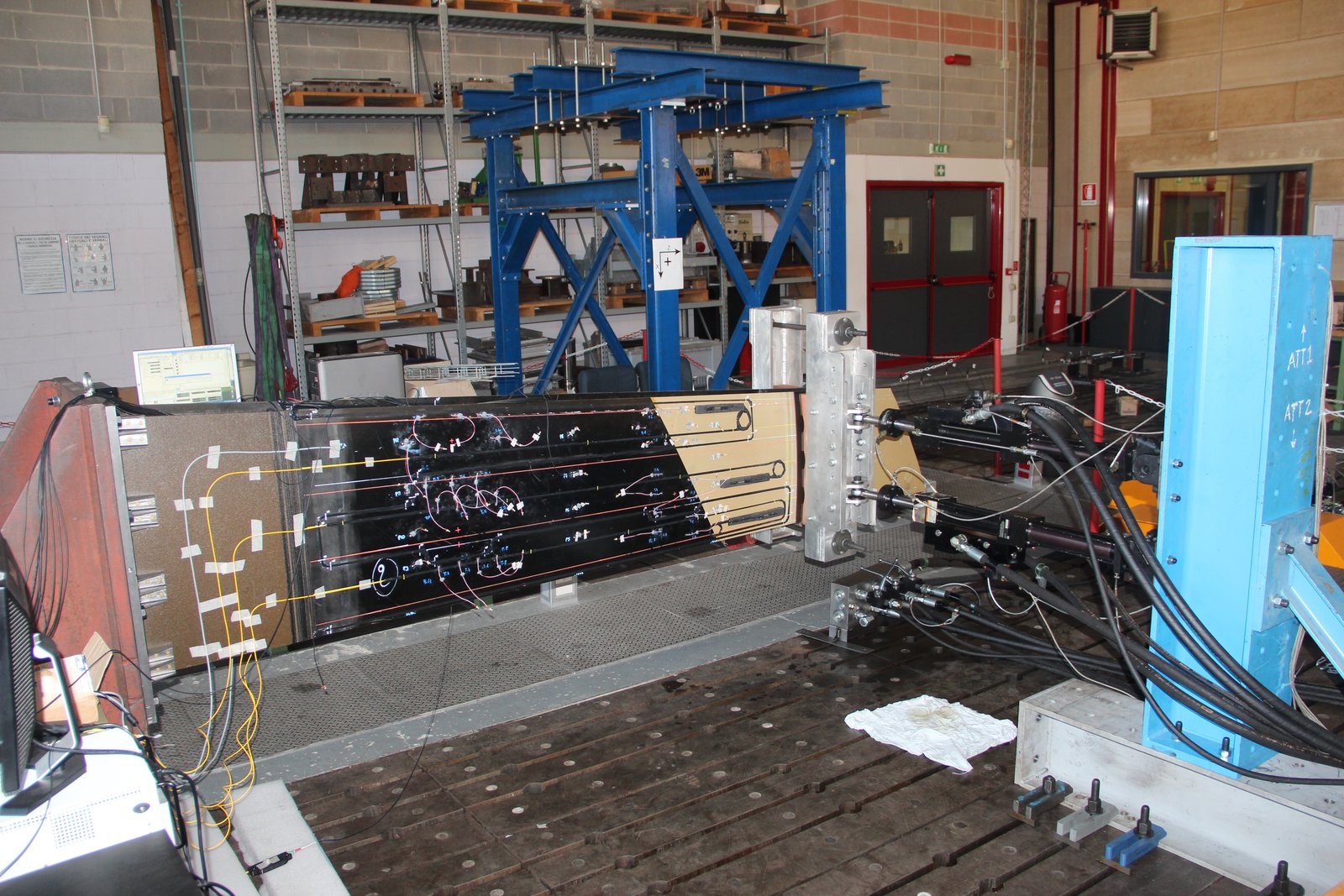
Research in images